CGH Tax
Services, LLC
about us
CGH Tax Services LLC is a dedicated small business owned and operated by Carolin G. Hink, who brings professionalism and personal attention to every client she serves. With a strong focus on accuracy, clarity, and trustworthy financial guidance, Carolin leads a small, skilled team that works closely together to provide comprehensive tax preparation and planning services. Their collaborative approach ensures that clients receive individualized support, whether they’re managing personal taxes or navigating the financial responsibilities of a business. CGH Tax Services LLC prides itself on building lasting relationships and helping clients feel confident and informed year-round.
25+ years experience
Annual CPEs
EA (Enrolled Agent)
master of science

Services
- Personal Tax Returns
- Small Business Tax Returns
- Bookkeeping
- New Business Registration

Child Care Credit
The Child and Dependent Care Credit helps working individuals and families offset the cost of care for qualifying dependents—typically children under age 13 or a spouse or adult dependent incapable of self-care—so the taxpayer can work or actively look for work. This credit allows you to claim a percentage of eligible care expenses, such as daycare, after-school programs, or in-home care services, up to IRS-specified limits. Because it reduces tax liability based on actual expenses paid, this credit provides targeted relief aimed at making employment more financially accessible for families requiring childcare or dependent care.

Child Tax Credit
The Child Tax Credit (CTC) is a federal tax benefit designed to help families manage the financial responsibilities of raising children by reducing their overall federal income tax. It provides a credit for each qualifying child under age 17 who meets IRS dependency, residency, and citizenship requirements. The credit directly lowers the tax you owe, and a portion may be refundable through the Additional Child Tax Credit if the total credit exceeds your tax liability. By lowering taxes or increasing potential refunds, the CTC offers meaningful financial support to households with children.

Various Credits
When filing U.S. tax returns, several major tax credits can reduce the amount of tax you owe—some even refundable, meaning you can receive money back even if you owe no tax. Key credits include the Earned Income Tax Credit (EITC), which benefits low- to moderate-income workers based on income and family size; the Child Tax Credit (CTC), which offers a credit for each qualifying child and may be partially refundable; and the Child and Dependent Care Credit, which helps offset costs of childcare or dependent care needed for you to work. Education-related credits include the American Opportunity Credit, which is partly refundable and helps with undergraduate education costs, and the Lifetime Learning Credit, which offers a nonrefundable benefit for a broader range of education expenses. Other common credits include the Saver’s Credit for retirement contributions, the Premium Tax Credit for health insurance purchased through the Marketplace, and various energy-related credits for installing qualifying clean-energy improvements in a home. These credits directly reduce tax liability and can significantly affect a taxpayer’s refund or amount due.

Schedule A
Schedule A is a supplemental form used with Form 1040 that allows U.S. taxpayers to itemize their deductions instead of taking the standard deduction, listing specific deductible expenses such as medical and dental costs, state and local taxes, mortgage interest and charitable contributions; by itemizing on Schedule A, taxpayers can reduce their taxable income when their eligible expenses exceed the standard deduction amount for the year.
Form 1040
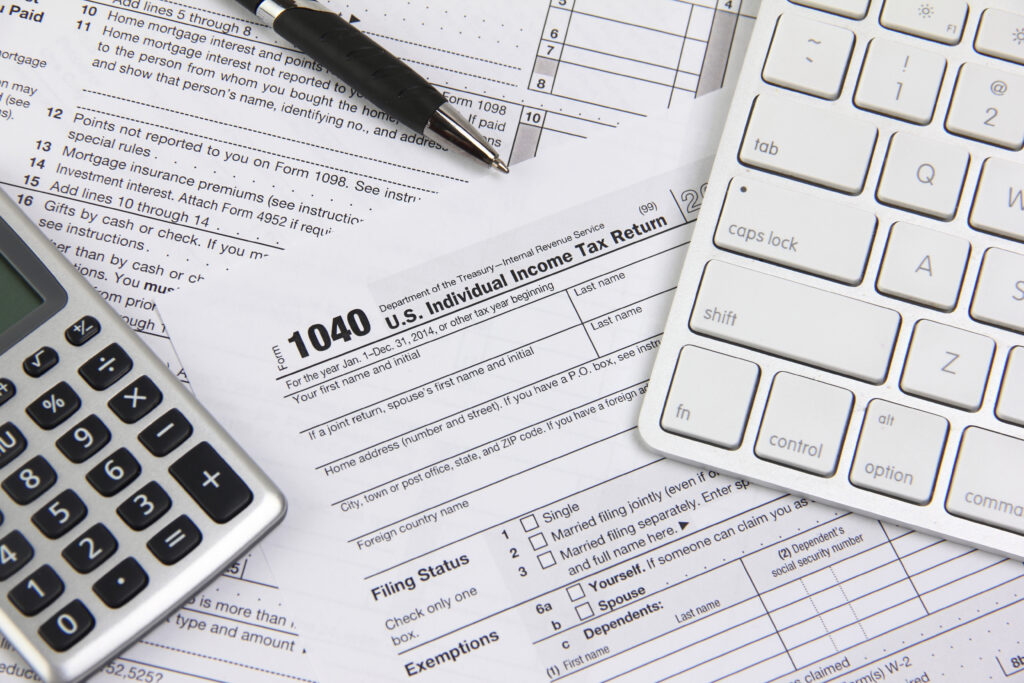
Form 1040 is the standard individual income tax return used by U.S. taxpayers to report their annual earnings, claim tax credits and deductions, calculate the amount of tax owed or refund due, and disclose other financial information required by the Internal Revenue Service (IRS); it serves as the central document for most personal federal tax filings, capturing income from wages, investments, self-employment, and other sources in order to determine a taxpayer’s final federal tax liability for the year.

Non-Profits
Filing taxes for a non-profit small business in the United States typically involves submitting an annual information return to the IRS—most commonly Form 990 or 990-EZ, depending on the organization’s size—which reports the nonprofit’s mission, governance, financial activities, and compliance with tax-exempt requirements rather than calculating income tax owed. Nonprofits must track and disclose revenue such as donations, grants, program service income, and any unrelated business income, as well as expenses tied to their charitable programs and operations; if they earn significant unrelated business income, they may also need to file Form 990-T and pay tax on that portion. In addition, maintaining tax-exempt status requires adherence to rules regarding political activity, compensation, recordkeeping, and public disclosure.
Schedule E (Rentals)
Schedule E is a supplemental tax form used with Form 1040 that allows individuals—including small business owners who earn income from rental properties—to report rental real estate income and expenses. It captures details such as rental income received, mortgage interest, property taxes, insurance, repairs, maintenance, utilities, depreciation, and other allowable expenses associated with managing rental property. The net profit or loss calculated on Schedule E flows to your main tax return and affects your overall taxable income. While rental activity is often considered a passive business for tax purposes, Schedule E provides the structure to accurately document the financial performance of rental properties and determine how much of that income is subject to federal income tax.

Schedule C
Schedule C is a form attached to Form 1040 that sole proprietors and single-member LLC owners use to report income and expenses from a business they operate as an individual; it details gross receipts, cost of goods sold, and various business expenses—such as supplies, advertising, home-office costs, and vehicle use—in order to calculate the net profit or loss from the business, which is then included in the taxpayer’s overall taxable income. The Schedule C is always filed as part of an individual’s personal tax return (Form 1040); there is no separate “small business tax return” for sole proprietors or single-member LLCs. So whether you think of it as “personal taxes” or “small business taxes,” the form is identical—the IRS simply considers the business to be part of your personal tax filing. Only businesses structured as partnerships, multi-member LLCs, S corporations, or C corporations file their own separate business tax returns, and those entities do not use Schedule C.
1099 for Subcontractors
A 1099 form for subcontractors—usually Form 1099-NEC—is the tax document a business must issue to any non-employee worker it pays $600 or more during the year, summarizing how much was paid so the subcontractor can report that income on their tax return. It’s used when the worker is truly an independent contractor (not an employee), and it helps the IRS track business-to-contractor payments. The hiring business must file the form with the IRS and provide a copy to the subcontractor, while the subcontractor is responsible for paying their own income and self-employment taxes on the reported earnings.
Payroll Services
Payroll services handle all the calculations and filings required to pay employees accurately and on time, including payroll source deductions such as income tax, employment insurance, and pension contributions that must be withheld and remitted to government agencies; they also ensure compliance with employment regulations by maintaining proper records and preparing reports, which becomes especially important during worker compensation audits where businesses must verify wages, job classifications, and premiums owed to workplace safety or workers’ compensation boards, helping organizations avoid penalties and maintain accurate, compliant payroll practices.
Sales Tax Returns
A sales tax return is a periodic report that businesses submit to state or local tax authorities to detail the amount of sales tax they collected from customers and to remit those funds to the government. It typically includes total sales, taxable sales, exempt sales, and the tax owed for the reporting period, which may be monthly, quarterly, or annually depending on the jurisdiction and the business’s size. Filing accurately and on time helps businesses stay compliant with tax laws, avoid penalties, and maintain proper financial records.
Online Quickbooks
Online QuickBooks reconciliation for small business accounts is the process of comparing the transactions recorded in QuickBooks with the actual activity shown on a business’s bank or credit card statements to ensure they match and are accurate. This helps business owners confirm that all income and expenses have been properly entered, identify any errors or duplicate entries, and catch missing transactions. By regularly reconciling accounts in QuickBooks, small businesses maintain accurate financial records, improve bookkeeping reliability, and make tax preparation and financial decision-making easier.
Registering with State
Registering with the state for a new business means officially filing the necessary documents with the appropriate state agency—typically the Secretary of State—to legally create and recognize your business entity. This process usually involves selecting a business structure, choosing a unique business name, and submitting formation paperwork such as Articles of Organization for an LLC or Articles of Incorporation for a corporation, along with any required fees. Once approved, the state formally acknowledges your business, enabling you to operate legally, open business bank accounts, obtain licenses or permits, and meet ongoing compliance obligations like annual reports or franchise taxes.
Federal EIN #
A Federal Employer Identification Number (EIN), also called a Federal Tax Identification Number, is a unique nine-digit number assigned by the Internal Revenue Service to businesses, nonprofits, estates, trusts, and certain other entities for tax administration purposes; it functions much like a Social Security number does for individuals, allowing the IRS to identify an organization when it files tax returns, opens business bank accounts, hires employees, or conducts other official financial activities, and it is required for most business structures except some sole proprietorships without employees.
Set up LLCs
Setting up LLCs (Limited Liability Companies) involves creating legally recognized business entities that protect owners’ personal assets while allowing flexible management and tax options. The process typically includes choosing a unique business name, selecting a state in which to form the LLC, filing Articles of Organization with the state’s business filing office, designating a registered agent to receive legal documents, and drafting an Operating Agreement that outlines ownership and management structure. Once approved, the LLC will need to obtain an EIN from the IRS, register for applicable state taxes or licenses, and maintain compliance through annual filings or fees, depending on state requirements.